Tuesday, March 27, 2012

Holiness

I've just finished Leviticus, Numbers, and Deuteronomy and I must say it was a tough journey.  The census in Numbers was of course some dry reading and many of the laws were tough to get through, but as I look back on these three books I see one major theme, holiness.  God commands holiness from His people.  He states time and time again that His people are a holy people and they are to be holy as He is holy (Leviticus 20:26, Leviticus 11:44, Deuteronomy 14:2, etc.)  So if this concept of holiness is so important to God and what it means to be His people, it might be a good idea for us to take a look at it.  What does holy mean? A search on Dictionary.com returns several definitions but the one I want us to focus on is this, holy is having a spiritually pure quality.  That's what God wants, spiritual purity, spiritual cleanliness.  This is evident throughout these books, and all of scripture I might add, but especially in these three books.  God requires that His people be set apart and spiritually clean.  Now in the Old Testament this cleanliness was achieved symbolically through the various sacrifices that were required.  But, let's look at how God exemplified this holiness in a way that demonstrated the cleanliness He desired.  If you were physically unclean (i.e. sickness, had contact with dead bodies, deformities, etc.) you could not come to the temple and were often times even required to stay on the outskirts of the Israelite camp.  Now, was God being cruel and unfair in these regards?  No.  Many of these prescriptions had health and sanitary components that were actually quite advanced for their time.  What God was doing was giving the people a visual reference to exemplify the extent of holiness He required.  The lamb you sacrificed had to be without blemish.  The goat you sacrificed had to be perfect.  The bull had to be perfect.  Everything had to be perfect!  With such a high standard of holiness, how could any one person ever hope to fully please God?  This is the exemplification of Romans 3:19-20 which says

 19 Now we know that whatever the Law says, it speaks to those who are [a]under the Law, so that every mouth may be closed and all the world may become accountable to God; 20 because by the works [b]of the Law no flesh will be justified in His sight; for [c]through the Law comes the knowledge of sin.

The law was not intended to save us but rather to show us how dreadfully short we fall in regards to the holiness that God requires.  So what can we do?  If God sets the bar higher than anyone is capable of reaching, what hope is there?  Enter Jesus!  The very next verses in Romans say

21 But now apart [a]from the Law the righteousness of God has been manifested, being witnessed by the Law and the Prophets, 22 even the righteousness of God through faith in Jesus Christ for all those [b]who believe; for there is no distinction; 23 for all [c]have sinned and fall short of the glory of God, 24 being justified as a gift by His grace through the redemption which is in Christ Jesus; 25 whom God displayed publicly as a [d]propitiation [e]in His blood through faith. This was to demonstrate His righteousness, [f]because in the forbearance of God He passed over the sins previously committed; 26 for the demonstration, I say, of His righteousness at the present time, so that He would be just and the justifier of the one who [g]has faith in Jesus.

Jesus reached the bar we could never obtain and made it possible for us to enter into God's presence with spiritual purity.  As I'm reading through the Bible, it is AMAZING how scripture is all linked together and how everything points to Jesus.  The strict holiness of the Old Testament serves to show us just how incapable and sinful we are and shows us the need for a Savior.  Then in the New Testament God sends us that Savior!  Amazing stuff!

Sunday, March 4, 2012

A Royal Priesthood

     Today I'm going to be looking at the New Testament as well because I think it's important that we remember the Bible is a whole book and that scripture in one place can help teach and expound upon scripture in another area.  As I read through Leviticus and Numbers I am astounded by the strict adherence that God requires of the priests and His people in regards to the tabernacle, sacrifice, and cleanliness.  It is extremely evident that God is a holy God and wants that His people be holy in the same way He is holy (Leviticus 11:44).  There are also some very serious punishments for those that fail to meet or respect the statutes that God has set up.  Many Israelites and even priests are sentenced to death for not exercising obedience to God's laws.  Now all this sounds pretty drastic but I think that God is trying to demonstrate to us the seriousness with which He views sin and I think we would do well to view sin in the same manner in which God does.  God placed a large responsibility on the Levites (priests) in regards to allowing them to conduct the business of the tabernacle and they were the intercessors between God and the people.  No one else could approach or intercede before the Lord, only the Levites.

     Now after Christ's death on the cross a beautiful thing happens.  The veil of the temple is torn and now all believers are welcomed into the presence of God.  1 Peter 2:9 says that we are now a royal priesthood.  We were saved by God for the sole purpose of serving Him as priests and proclaiming His excellencies and His glory.  What a huge responsibility and honor!  Given the seriousness with which God viewed the priests in the Old Testament I think we, as believers, should take our new responsibility as a "royal priesthood" with extreme seriousness.  God has saved us and entrusted us with the responsibility of priesthood.  What does priesthood mean and look like for us today?  Well as priests we are to exemplify God to those around us.  We are to represent God.  One quote I'm reminded of is that "you may be the only Bible some people ever read" and therefore we should make every effort to ensure that our lives, as royal priests, are a reflection of God's glory to those around us, especially those that may not know Him.

Sunday, February 12, 2012

Abraham, Isaac, & Jacob: A Legacy of Faith

Hey everyone, I apologize for the lull in posts over the past few weeks, but life can get busy.  I'll be doing two posts over the next few days to try and catch everyone up.  There's so much to discuss.  I'm finishing up Exodus tonight but I want to go back and touch on the patriarchs in this post if I may.

We often equate these three men with immense faith and trust in God and rightly so.  However, I think we need to remember that they were men, just like us.  They had their struggles, they had their short comings.  Just look at each of them:


Abraham
  • Disobeyed and showed distrust in God by lying about his relationship with Sarah to Pharaoh.
  • Did not trust God's timing and gave in to his wife's offer of Hagar so as to produce an heir.
  • Lied a second time concerning his relationship with Sarah


Isaac
  • Followed in his father's footsteps by lying about his relationship with his wife Rebecca in an effort to save himself.
  • After the prophecy concerning his sons, he still tried to bless his first born to follow customary norms, instead of God's plan.
Jacob
  •  His very name meant supplanter
  •  Deceived his blind father into blessing him instead of his brother
Now, I don't note these shortcomings to bring an unfavorable light on these guys, but simply to show that they were still human.  However, each one of them was still part of God's promise.

What does this mean for us?  It means that we don't have to be perfect to win God's favor.  We don't have to figure it all out and get it all right before God will use us.  It means that God still works in our shortcomings.  He is a God of mercy and forgiveness.  He can work in spite of our getting in His way.  There is nothing we can do that can keep Him from being faithful to His word.  He promised to make Abraham a great nation and He is faithful to that promise.

Monday, January 23, 2012

The Life of Abraham

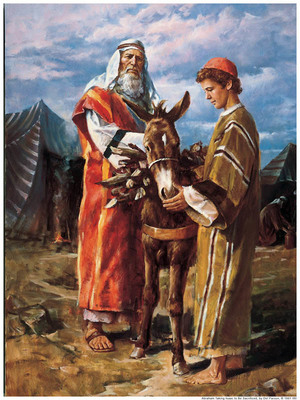
     As I finish reading about the life of Abraham I'm taken a back by the sheer faith of this one man.  When God called him to leave his father and set out for a new land, God never told him where he was going.  He only said "go to a land that I will show you".  The story of Abraham starts off with a magnificent display of child-like faith.  No wonder this man is listed among the heroes of the faith in Hebrews.  But I think it's very important to note that Abraham was just as human as the rest of us.  As he went through Egypt we see that, in an effort to protect himself, he lied about his relationship with Sarah.  This man who trusted God enough to leave his father and go to an unknown land didn't trust the same God to get him through one country unharmed!  And this would not be the first time Abraham takes matters into his own hands and doesn't trust God to provide.  It's important for us to remember that even the Christians that we see as strong leaders are still human.  We should never put another believe on a pedestal to the point where they achieve "super human" status.  Only God should be given that place.  And so the same goes for Abraham.  A great man.  The father of the Jewish and Christian faiths.  But human none the less.

     Still Abraham showed incredibly strong faith throughout his life.  He even went so far as to being willing to sacrifice his own son.  He was willing to give up the son he had waited 100 years to receive!  All because the Lord asked it of him.  Oh, what we could learn from Abraham.  Could you imagine if we all had faith of that magnitude?  The things that would be accomplished are unimaginable.  Don't get me wrong.  God can use the measure of faith that He has given to each of us in might ways.  But if the church would serve with the faith of Abraham, it would be a powerful thing.

     Now, I want to make sure God get's His due credit and is glorified in all this.  I found something particularly beautiful about God in chapter 15.  In this chapter God is promising to provide an heir for Abraham.  God promises to protect Abraham and to reward him.  Abraham asks that God would provide him a son to be heir to his household and God enters into a covenant with Abraham.  You probably know the words of this covenant very well.  God asks Abraham to count the stars and then tells him "so shall [his] descendants be" and they will inherit the "promised land".  In order to seal the covenant God asks Abraham to provide a 3 year old heifer, a 3 year old female goat, a 3 year old ram, a turtle dove, and a young pigeon.  Now Abraham proceeded to cut these each into two halves and lay each half to the side.  As was custom when entering into a covenant, both parties would pass through the two halves symbolizing that the same fate should be theirs, should they break the covenant.  Now the amazing part comes in at verse 17.  Prior to this, before Abraham could walk between the two halves, God put him into a deep sleep.  Then this happened:

"It came about when the sun had set, that it was very dark, and behold, there appeared a smoking oven and a flaming torch which passed between these pieces" Gen 15:17

     Did you see it?  God himself passed through the halves.  God sealed the covenant Himself.  He did not let Abraham pass through because the covenant required nothing on Abraham's part.  God took it all upon Himself.  What an amazing God?  We serve a God who took it upon Himself with Abraham and also took it upon Himself on the cross of Calvary.  We serve a God who knows we can never reach Him so He reaches to us.  Thanks be to God!

Sunday, January 15, 2012

Learning to Trust


     The book of Job has proven to be quite a trying book.  In the beginning I found it hard to understand the reasons for Job’s suffering.  I’m still not sure why He had to suffer the way he did but as I reached the end of the book I came to the realization that maybe I was not intended, we we’re not intended, to know the full reasons for Job’s suffering.  In the end God vindicates Job and restores to him all his possession two-fold, but Job is still never given an answer for why he has had to suffer.  God does not make him privy to the beginning dialogue between Himself and Satan and the subsequent trials and suffering that follow.  All God tells Job is that he should trust Him and I think that is the main purpose of the book. 

     Just like Job we are supposed to trust God.  As readers we are supposed to trust that Job’s suffering was not in vain and as believers in our world today we are trust God that the suffering and trials that we endure and that we see around us serve a greater purpose that is not necessarily available to our wisdom.  So I believe one of the overall themes of this book is trust, in the face of all circumstances.  Trust in the Lord as the supreme Judge who will right all wrongs and, while it may seem like it for the time being, will not allow the wicked to prosper forever.  Trust that the Lord is working all things for our good even though it may not seem like it in the moment.  And lastly, to trust in the Lord as protector and deliverer because ultimately He will deliver, as we will see and continue to see in the sacrifice of Jesus.

"Though He slay me, I will hope in Him..." Job 13:15

Monday, January 9, 2012

A Finite Perspective on Fairness

     So I've reached Job 23.  This is one tough book.  I did some background reading on the book of Job to try and get some better understanding on the themes of the book and the overall purpose and I found some good stuff.  I think there are several "take home" points for this book and God can certainly meet each of us in a special way in through Job.  The biggest take home point for me has been the sovereignty of God.


     I think the topic of sovereignty is one that, like the book of Job itself, can prove to be somewhat uncomfortable to our minds, and our pride, on some occasions.  Many of the questions that I had in my earlier post are clear examples of how the sovereignty of God was not meshing well with what I perceived as fair.  Fair.  Now that's an interesting notion.  There is not one bit of this book so far that seems fair.  But what is fair?  Who determines fair?  Sure I can say that something isn't fair, but my conclusions would be based on incomplete, finite wisdom.  Therefore, just because I deem something unfair from my perspective doesn't always mean that's the case.  Let me illustrate my point.  When I was a little kid and I wanted to go to a party with some friends my parents would always ask, "will there be adults there?".  If the answer was no, I wasn't allowed to go.  Now all my friend's parents were letting them go so to my 15 year old mind, that was not fair that I couldn't go.  However, I was reasoning from a 15 year-old's very finite wisdom.  My parents had many years of experience and maturity that I did not have and therefore, while them not allowing me to go to the party seemed unfair to me, at my parent's more experienced and higher level of reasoning that rejection was serving as protection for me, although I couldn't see it at the time.

     The same is true for God.  What may seem unfair to us, may be the means to a higher, more holy end than we can perceive in our minds.  Think about it.  How many times do we look back at struggles and trials in our lives that, at the time, didn't seem very fair only to realize that God had a beautiful plan for our lives that would not have been possible without that trial.  That's what I'm getting at.  What we reason as unfair, may have larger implications on a heavenly level.  God is sovereign.  He operates from a wisdom that FAR exceeds human minds.

"For as the heavens are higher than the earth, So are My ways higher than your ways And My thoughts than your thoughts." - Isaiah 55:9


    It's not comfortable sometimes to think that God is sovereign over us and that He may allow something "unfair" to happen in our lives that we can do nothing about.  I think we can see that Job even thought the same thing.  However, as Christians we are to trust the Lord and trust that in ALL things He is working for the good of those who love Him.

"For I know the plans that I have for you,' declares the LORD, 'plans for welfare and not for calamity to give you a future and a hope." -Jeremiah 29:11

"And we know that God causes all things to work together for good to those who love God, to those who are called according to His purpose." -Romans 8:28

     It is not our place to instruct God how to work in our lives or determine what is a fair or unfair action on His part.  We are the created and NOT the Creator...and we do well to remember that!

Friday, January 6, 2012

The Patience of Job?

Well  I'm 9 chapters into the book of Job and I have to say, this book is proving to be a challenge.

  1. The poetry form that it's written in is pretty hard to follow.  I'm having to read the foot notes to make sure I'm understanding correctly, haha.
  2. The human-nature in me is not very comfortable with what Job is being put through, and doesn't quite understand why.
I think that Job should make all of us a little uncomfortable.  If it doesn't I'm not saying there's anything wrong with you but I find it very hard, in my finite mind, to reconcile this situation.  Why does Job have to go through this?  Why Job?  What was the point of the trials?  Why let Satan do the things he did?  What purpose did it serve?

These are all questions that I have as I read this book.  It's hard but I have to trust that God had a reason for Job dealing with what he had to deal with.

I know we often talk about the patience of Job but as I was reading last night I saw that Job was just as human as we were.  He never cursed God but he did insinuate that was being unfair and unjust:

"It is all one; therefore I say, 'He destroys the guiltless and the wicked."
"If the scourge kills suddenly, He mocks the despair of the innocent."
"The earth is given into the hand of the wicked ; He covers the faces of its judges. If it is not He, then who is it?"
"Now my days are swifter than a runner ; They flee away, they see no good." 
 -Job 9:22-25

I can't say that I blame Job right now.  I'm hoping that God will make sense of all this later on in Job's story, but until then I'll just keep trudging along.

What do you think?  Anyone have any insights into Job?  I'd love to hear them!

God bless!!